Singapore's BMW-Inspired Business Class Is a Bold Gamble
Singapore's next-generation Business Class looks unlike anything the airline has offered before. But behind its unusual design is a deliberate bet on what passengers actually want.


Business Class has a sameness problem.
In recent years, airlines have been racing to refresh their premium cabins, capitalizing on a K-shaped economy and growing demand for lucrative premium seating. One of the quickest ways to do so is by selecting an one of just a handful of seat designs from an established supplier. And while these seats are admitedly quite sophisticated, their ubiquity means that carriers are starting to lose some of their individuality.
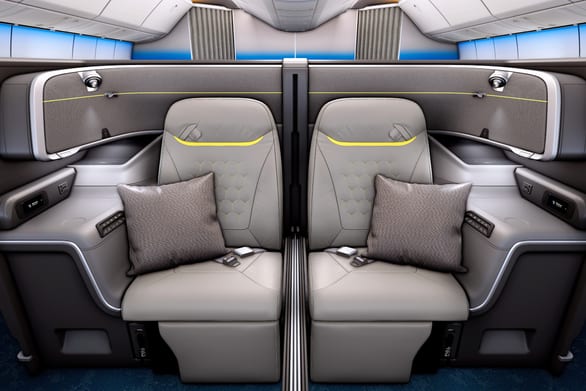
Singapore Airlines has decided to take a different approach. As part of its S$2 billion (US$1.56 billion) investment in its next-gen long-haul cabins, the airline’s unveiled an entirely bespoke Business Class product developed in partnership with BMW’s design division. The result is one of the most unusual Business Class seats we've seen in a while.

Taking Inspiration From the Automotive World
Before developing its new cabins, Singapore Airlines conducted extensive research involving more than 5,000 frequent travelers, customers, staff, and industry experts across different markets. In doing so, the airline sought to understand what passengers actually valued most about their onboard experience.
What it found was that passengers in different cabins had very different priorities. First Class passengers, for instance, placed an enormous emphasis on privacy; they wanted to feel as though they weren't even on a plane. Consequently, Singapore worked with PriestmanGoode to develop a product that draws heavily on luxury hospitality.
By contrast, Business Class travelers stressed a desire for improved comfort and ergonomics. They wanted seats that better supported their bodies, particularly during extended periods of sitting and sleeping.
This is where BMW comes into the picture. Its Designworks arm helped Singapore develop a product inspired by high-performance automotive seating, particularly the BMW M series. The result is a product that looks and functions differently from off-the-shelf components.

Designed Around the Human Body
At the heart of Singapore's new suite is a seat with substantially improved ergonomics. It features electronically controlled upper and lower lumbar support, adjustable leg rests, and coordinated reclining movements - all of which work together to provide more natural support throughout the journey. And thanks to new technology integrated with the airline's KrisWorld IFE system, passengers can even save their preferred seating positions for future flights, which should eliminate the need to repeatedly fiddle with the controls.
Singapore has also paid particular attention to the sleeping experience. The seat converts into a fully flat bed measuring 79 inches long and up to 24 inches wide. An innovative table mechanism allows the table to stow at an angle, opening up a generously sized footwell that gives passengers more freedom to reposition their legs while sleeping.
This addresses one of the biggest criticisms of Singapore's existing Business Class. While the current seat is exceptionally wide (and is one of my favorite seats in the sky), its relatively small, off-center footwell can make sleeping uncomfortable, particularly for taller passengers. The redesigned footwell should go a long way toward addressing that complaint.
Selected middle seats can also form companion beds, with electronically adjustable privacy dividers allowing passengers traveling together to create a shared sleeping space. And while every suite features a sliding privacy door, Singapore deliberately avoided making the surrounding walls excessively tall. The objective was to provide privacy without leaving passengers feeling boxed in - an approach I wish more airlines would take.

More Than Just a New Seat
The new Business Class also introduces substantial improvements to entertainment, connectivity, and onboard amenities.
On its retrofitted A350s, Singapore will install 22-inch 4K OLED touchscreens, while its Boeing 777-9s will feature 20-inch 4K displays. Both versions will support spatial audio, active noise-cancellation headphones, and Bluetooth pairing.
The updated KrisWorld entertainment system will offer more than 2,500 entertainment options, alongside a redesigned interface, improved search capabilities, and a new wellness planner featuring meditation, breathing exercises, and in-seat stretches. Wireless charging, USB-C connectivity, universal AC outlets, and Starlink connectivity round out the technology upgrades.
The airline is also making some noteworthy improvements to its soft product. For the first time, Singapore Airlines Business Class passengers will receive dedicated sleeper suits, accompanied by slippers. New padded bedsheets incorporating memory foam will also provide additional cushioning and support when the next-generation seats enter service.
Meanwhile, Singapore has partnered with Swedish luxury brand BYREDO to introduce new amenity kits featuring its Blanche fragrance, hand cream, and lip balm.
Unlike the new seats, which are scheduled to enter service progressively from the second half of 2027, the amenity kits and sleeper suits are beginning their rollout in November 2026.

A Bold (and Potentially Polarizing) Color Choice
Despite all these improvements, I suspect the first thing people will notice about the new Business Class is its appearance. The design is a dramatic departure from Singapore's existing products, particularly when it comes to the color palette.
Gray dominates the cabin, with pops of bright yellow and blue scattered throughout. The overall aesthetic is decidedly more automotive and futuristic than the warm, understated luxury we've come to associate with the Singapore of yesterday.
Frankly, I'm not sold on the color palette (though I think it does look substantially better in person than it does in renders). Even so, I think the airline deserves credit for trying something different. Bespoke Business Class products are expensive and complicated to develop. Certification requirements have become an increasingly significant consideration, and introducing an entirely new seat carries considerably more risk than selecting an established design.
Singapore could have taken the easy path here. Instead, it has commissioned a product that deliberately stands apart from its competitors - in both appearance and functionality.
Ultimately, whether the new seat looks good is a matter of personal preference. And until passengers spend meaningful time in these seats, we won't know whether the ergonomic improvements deliver on their promise. But in today's age of cost-cutting, I think there's something refreshing about an airline that's willing to take a risk to create a genuinely different product. And Singapore deserves all the credit for doing exactly that.
Photos: Singapore Airlines