
The Captain Flying Lufthansa's Last A340-600 Won't Miss It
Hours before Lufthansa's final A340-600 flight, I sat down with the captain flying it. Here's what he told us about the aircraft, why it's leaving, and the jets replacing it.


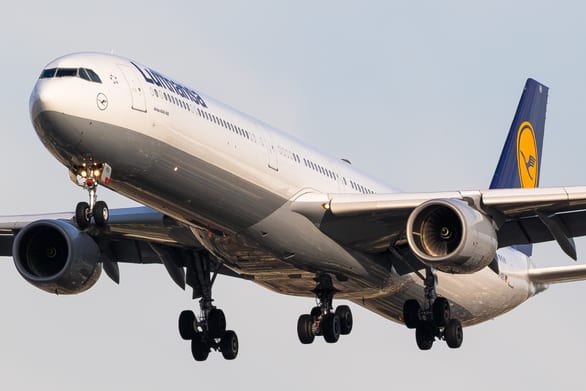
Hours before Lufthansa's final A340-600 flight, from Washington Dulles to Frankfurt, I sat down with the captain flying it. Here's what he told us about the aircraft, why it's leaving, and the fleet overhaul replacing it.
On the evening of Oct 18th 2026, a Lufthansa Airbus A340-600 will depart Washington Dulles airport and embark on its final Atlantic crossing. But the captain flying it isn't getting sentimental.
"We will remember the airplane," he told us. "But economically, as a manager of Lufthansa, we will not miss the airplane."
That captain is Francesco Sciortino, a Lufthansa Airlines board member and the airline's Hub Manager in Frankfurt. I joined Francesco and the Lufthansa team for a small media session ahead of the flight, which l'll be on, too.
It might sound like a cold goodbye, but it says a lot about where Lufthansa is right now. The airline is in the midst of what its own people call the biggest long-haul fleet transformation in its history, and retiring the A340-600 (painful as it may be) is a critical step in that overhaul.

Not Just a Longer A340
For 23 years, the A340-600 has been one of the most recognizable jets in Lufthansa's fleet, carrying more than 40 million passengers. Francesco has spent his fair share of time on board. He first flew the A340 family as a first officer, left to captain the A320, then came back and has flown it for about 10 years since. And while he's flown both of Lufthansa's A340 variants, the -600 is distinct.
"It's more than 100 tons heavier than the A340-300," Francesco said. "And 100 tons makes a difference." It's also nearly 12 meters longer.
That extra size makes the -600 a very different airplane to operate, particularly on the ground. Its main landing gear sits 35 meters behind the cockpit, so it has its own taxi cameras, including one beneath the fuselage to help pilots keep track of its position. Its size also limits which taxiways it can use, and the specialized towing equipment it requires isn't something every airport has sitting around anymore.
The quirks aren't limited to the cockpit, either. The A340-600 was one of the first aircraft where Lufthansa moved the galley downstairs, using an elevator to bring meal carts up to the main cabin. That setup is no longer used, but it was still running when Francesco started flying the jet.
"At the end, it was really a different airplane," he said. "It was not just a derivative of the 340."

The Fuel Burn Problem, and What Replaces It
These quirks make the A340-600 a fascinating airplane, but not exactly an economical one. Take Lufthansa's former Los Angeles to Frankfurt service. Francesco said the A340-600 would be loaded with more than 100 tons of fuel for the crossing, while a 787 would need just 60 to 70. The two jets tackle slightly different parts of the market, so it's not a perfect apples-to-apples comparison. But it shows just how far aircraft efficiency has come in two decades.
The 787 is also about 20 minutes faster across the Atlantic, according to Francesco. In other words, the A340-600 burns more fuel and takes longer to get passengers where they're going.
Of course, the 787 isn't really a direct replacement for the A340-600. In terms of capacity, that job falls more on the soon-to-be delivered A350-1000 and 777X, and Lufthansa expects its first A350-1000 before the end of the year.
In the meantime, the Dreamliner has been a tremendous stand-in, and that fleet is growing at a remarkable clip. Lufthansa has gone from five 787s to 20 in about a year, with a new one arriving in Frankfurt every four to five weeks. Three more are due before the end of 2026, bringing the total to 23.
"If I look at the 787, to introduce 20 long-range airplanes within one year, not many organizations are able to do this," Francesco said.
And Lufthansa isn't slowing down anytime soon. Between narrowbodies and widebodies, it expects roughly one new aircraft every week for the foreseeable future.
Then there's the 777X, which has been a much longer time coming. Francesco acknowledged Lufthansa would have liked the jet years ago. "We had to wait for the 777," he said. "We're still waiting, but it looks like we [will] get it next year."
Lufthansa now hopes to fly its first 777Xs commercially in 2027. When the jet does arrive, Lufthansa's 787 and 777 pilots will be able to fly both types interchangeably, giving Frankfurt more than 50 Boeing widebodies that draw from the same pool of pilots.
"It makes us much more flexible," Francesco said.
The Training Queue
Of course, new airplanes are only half the challenge. Lufthansa also needs pilots to fly them.
Over the next three years, the airline plans to train around 1,000 pilots for its new widebodies. That's nearly one pilot completing training every single day. Around 800 of them come from the outgoing A340 fleet, with the vast majority moving to the 787.
Now, you'd think the A350 would be the more obvious transition choice. A340 pilots already know Airbus, and the jet shares a lot of design and systems philosophies with the A350. But Lufthansa has found that a surprising number of them actually prefer the Boeing.
"We thought all these Airbus pilots want to go to the 350," Francesco said. "But a lot of them want to go to the 787."
In fact, the Dreamliner has proven so popular that its captain slots are booked out through the end of 2027.

Does Lufthansa Lose Something?
The departure of the A346 raises a bigger question. Most airlines moved on from aircraft like this long ago, and Lufthansa is one of the few major carriers that still flies vintage widebodies. For aviation enthusiasts, it’s part of what makes the airline special. So as these jets disappear, does Lufthansa risk losing a piece of its identity?
Francesco doesn't think so, at least not from a passenger's perspective. "At the end, they want to have a nice journey with a modern airplane," he said. For most travelers, a comfortable seat and good service matter far more than the aircraft type.
That's where Lufthansa's broader refresh comes in. Alongside the new fleet, it's rolling out Allegris cabins across every class and a revamped PaxEx program called FOX (Future Onboard Experience). Francesco acknowledged Lufthansa has been "lagging a little bit behind" while waiting on new aircraft. But a year or two from now, he's confident "everything will be changed for the better."
"[I've been working for 30 years in Lufthansa," he said. "I think I never had a transformation like this so fast."
The A340-600 is just the beginning. If all goes to plan, Lufthansa's A330s will move to other Lufthansa Group airlines by the end of 2027, most likely Discover Airlines, while the A340-300 and 747-400 retire around the same time. Then again, given how many times the A340-600's own retirement was pushed back, those plans could change.

What Happens to This Airplane?
D-AIHW, the aircraft operating tonight's final flight, is just 17 years old. And while the A340-600 no longer makes economic sense for Lufthansa, the airplane itself is still in remarkably good condition.
"After 23 years, today we will fly back to Frankfurt and everything is working, everything is in perfect shape," Francesco said of the type. "It's not like in your car, where the window lever doesn't work anymore."
That means the jet still has utility, just not as a complete package. Just three hours after landing in Frankfurt, D-AIHW will head to Düsseldorf to have reusable and sellable components removed. From there, it's off to storage in Spain, where it could find a new owner.
For those hoping to see an A340-600 preserved, there's no good news yet. As far as the Lufthansa team knows, none of the airline's A340-600s are headed for a museum.

One Last Crossing
Francesco doesn't remember his first flight on the A340-600. What stands out are the journeys that followed, especially the many long-haul flights to Asia and China. And while he never felt especially sentimental about the airplane during all those years, today is different.
"Today, yes, because it's the last flight," he said. "When you lose something, then you look back."
He’ll be joined tonight by a full house; tonight’s flight is completely full. However, Lufthansa is quick to point out that this was true of yesterday's departure as well. In other words, all the demand isn’t just driven by aviation enthusiasts - the airline is still seeing strong demand regardless of the type of jet that’s being operated.
Even so, the A346 is going to be missed. I think Francesco put it best: "There's a good old pilot saying. If the aircraft looks nice, it flies nice."
Tonight, this beautiful old bird gets one last crossing to prove that saying right.